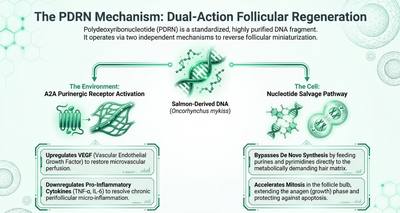
PDRN Clinical Outcomes: What 12-Week Trials Show
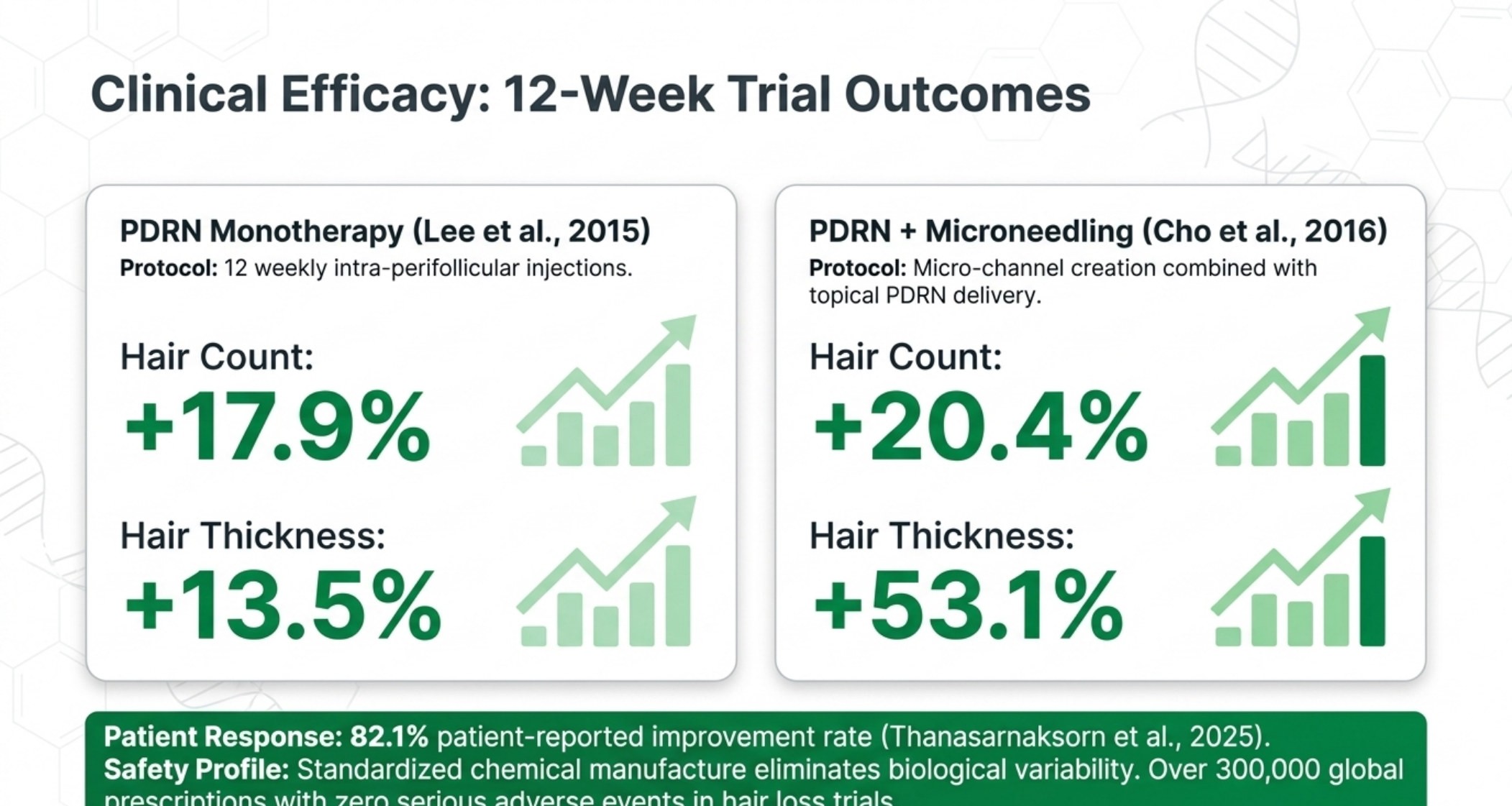
The shortest honest answer on PDRN is a set of four numbers. In 12-week data, 12 weekly intra-perifollicular injections of PDRN produced +17.9% hair count and +13.5% hair thickness as monotherapy, while creating micro-channels and delivering PDRN topically through them produced +20.4% hair count and +53.1% thickness. Patient-reported improvement reached 82.1%. If you are evaluating regenerative hair treatments in Carlsbad, those endpoints — not the phrase "stem cell" — are the benchmark to compare against, because they are the only regenerative outcomes in this deck that come with a named trial and a defined protocol.
The same body of evidence carries a safety figure of over 300,000 global prescriptions with zero serious adverse events in hair loss trials. Read together, the count, thickness, responder and safety numbers describe a treatment whose gains are modest in absolute terms but reproducible and low-risk — a very different proposition from the unapproved biologic products sitting in the same market category.
How the two 12-week protocols were structured
The trials differ in delivery, and delivery turns out to be the variable that matters most. The monotherapy protocol from Lee et al., 2015 used 12 weekly intra-perifollicular injections, placing the nucleotide directly into the tissue surrounding the follicle. The combination protocol from Cho et al., 2016 created micro-channels in the scalp and then delivered PDRN topically through them, using the channels as an access route rather than relying on injection alone.
Both arms ran to 12 weeks and both measured the same two endpoints: hair count and hair thickness. That shared endpoint structure is what makes the comparison usable — the difference in results can be attributed to delivery rather than to how success was defined.
| Protocol | Delivery method | Duration |
|---|---|---|
| PDRN monotherapy (Lee et al., 2015) | 12 weekly intra-perifollicular injections | 12 weeks |
| PDRN + microneedling (Cho et al., 2016) | Micro-channel creation plus topical PDRN delivery | 12 weeks |
Headline outcomes: count and thickness side by side
Monotherapy produced +17.9% hair count and +13.5% thickness. The combination arm produced +20.4% count and +53.1% thickness. The count figures sit close together — a 2.5 percentage-point gap — while the thickness figures diverge sharply, with the microneedling arm roughly four times the monotherapy result.
That pattern is the single most useful thing in the dataset for a patient. If your goal is density, the two delivery routes perform similarly on count. If your goal is calibre — hair that reads as fuller because each shaft is thicker — the combination protocol is the one the numbers favour, and the gap is large enough that delivery route should be an explicit question in any consultation.
| Endpoint | PDRN monotherapy | PDRN + microneedling |
|---|---|---|
| Hair count | +17.9% | +20.4% |
| Hair thickness | +13.5% | +53.1% |
| Patient-reported improvement | 82.1% (Thanasarnaksorn et al., 2025) | |
Patient-reported response and the safety record
Two of the four headline figures describe the follicle itself — count and thickness — and two describe the experience of treatment: how many patients judged their hair improved, and how many were harmed. Keeping those categories separate is what prevents a responder rate from being quoted as if it were a measured regrowth figure, and it is the distinction a Carlsbad provider should be able to draw without prompting.
The 82.1% patient-reported improvement rate reported by Thanasarnaksorn et al., 2025 is a subjective endpoint, and it should be read as one: it captures how patients judged their own change, not an independently counted measurement. Its value is that it was recorded alongside the objective count and thickness data rather than instead of it, so a high responder rate does not stand in for a measured effect.
On safety, the deck cites over 300,000 global prescriptions with zero serious adverse events in hair loss trials. The stated reason is manufacturing rather than luck: standardized chemical manufacture eliminates biological variability, so the product does not inherit the batch-to-batch inconsistency that complicates donor-derived biologics. That is the mechanism a low adverse-event rate depends on.
| Measure | Value | Type of evidence |
|---|---|---|
| Hair count change | +17.9% / +20.4% | Objective, counted |
| Hair thickness change | +13.5% / +53.1% | Objective, measured calibre |
| Patient-reported improvement | 82.1% | Subjective, patient-judged |
| Serious adverse events | Zero across 300,000+ prescriptions | Post-market, manufacturing-linked |
Reading the outcomes against the 2026 regulatory picture
A 12-week protocol producing +17.9% count and +53.1% thickness in a combination arm looks unremarkable beside the promise attached to exosomes, where early trials report Wnt/β-catenin activation and +35 hairs/cm². The difference is that one of these modalities has a defined protocol, named trials and a distribution record, and the other does not. As of 2026 the FDA has approved zero exosome products for hair restoration, dermal infiltration, or aesthetic injection.
Failed exemption criteria under 21 CFR 1271 — minimal manipulation and homologous use fail outright, while the no-combination and no-systemic-effect criteria often fail — classify standard exosome products as Investigational New Drugs requiring authorized Phase I–III trials before commercial administration. That is why the deck's 2026 guidance tells practices to implement PDRN and activated PRP now and monitor exosomes until trials mature.
For a patient in Carlsbad or anywhere else in California, the practical test is to ask a provider for the protocol, the number of sessions and the endpoint they are tracking. A defensible answer names the molecule, the delivery route and a 12-week checkpoint rather than describing the treatment in general terms. You can see how the treatments rank on the efficacy scale, compare what each approach costs without published price claims in the cost guide, and see how a course of treatment is sequenced on how it works.
| Modality | 12-week outcome data | 2026 status |
|---|---|---|
| PDRN monotherapy | +17.9% count, +13.5% thickness | Legally defensible, evidence-backed |
| PDRN + microneedling | +20.4% count, +53.1% thickness | Legally defensible, evidence-backed |
| MSC-derived exosomes | +35 hairs/cm² reported in early trials | Unapproved biologic, IND-classified |
This is educational information, not medical advice, and a qualified provider should assess the individual case before any regenerative protocol is started.
Frequently Asked Questions
How much hair do you actually gain from 12 weeks of PDRN?
Counted outcomes were +17.9% hair count and +13.5% thickness for PDRN monotherapy, and +20.4% count and +53.1% thickness when PDRN was delivered topically after microneedling created micro-channels. The 82.1% figure is a patient-reported improvement rate, which is a separate, subjective measure.
Is the 82.1% improvement rate the same as a measured result?
No. The 82.1% patient-reported improvement rate (Thanasarnaksorn et al., 2025) records how patients judged their own change, while the count and thickness percentages are counted and measured endpoints. The objective endpoints are +17.9%/+13.5% for monotherapy and +20.4%/+53.1% for the microneedling combination.
Why would a clinic use PDRN rather than exosomes in 2026?
Because as of 2026 the FDA has approved zero exosome products for hair restoration, dermal infiltration, or aesthetic injection, and failed 21 CFR 1271 criteria classify them as Investigational New Drugs. PDRN carries over 300,000 global prescriptions with zero serious adverse events in hair loss trials and is labeled legally defensible and evidence-backed.
Get matched with hair restoration professionals →
Ready for a Professional Review?
We can connect you with qualified hair restoration professionals who can map your situation to the right treatment.
Get Matched with Hair Restoration Professionals