How PDRN Regenerates Follicles: A Dual-Action Mechanism
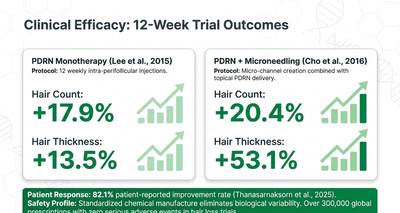
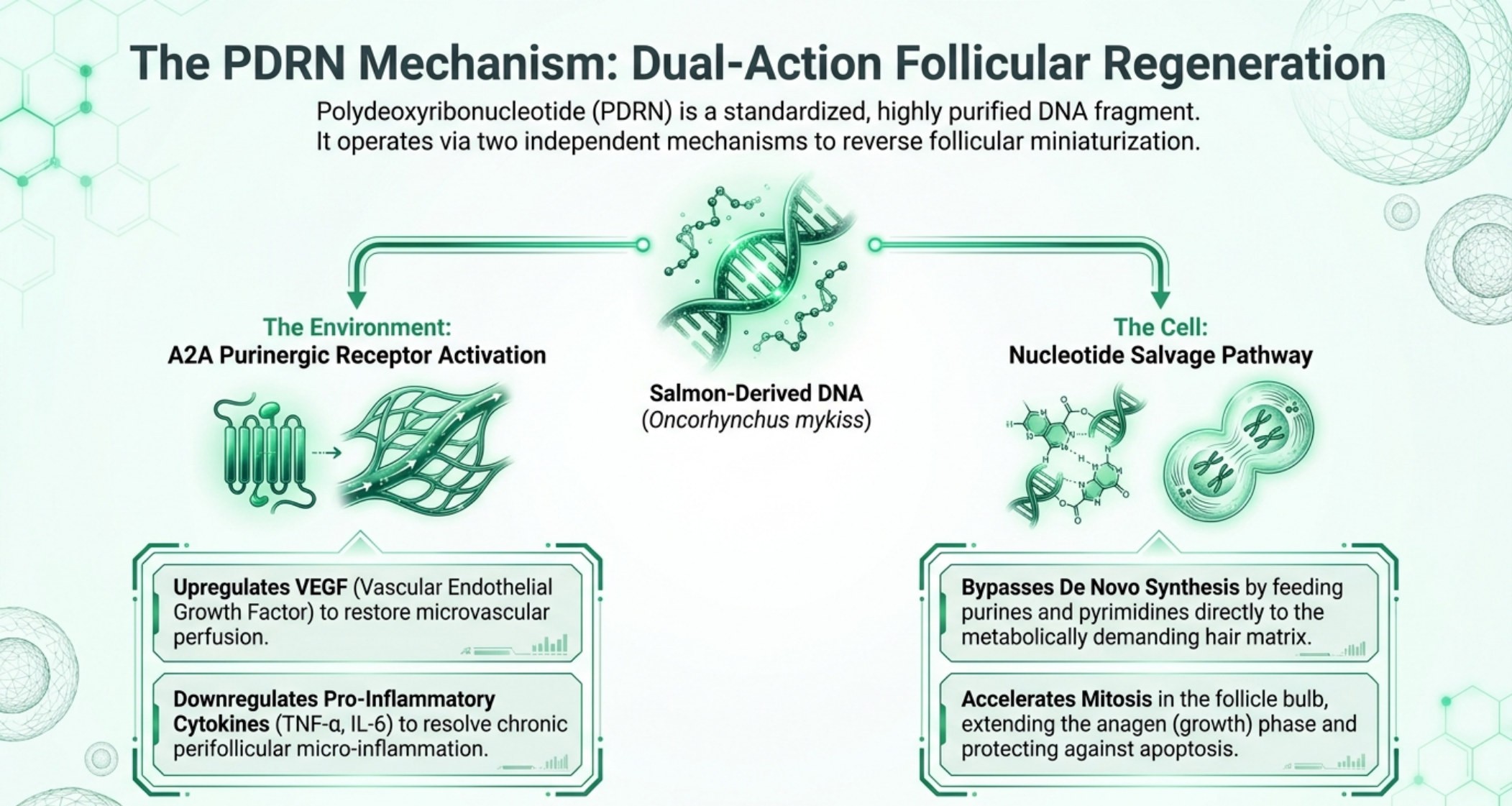
Polydeoxyribonucleotide, or PDRN, is not a growth serum sprayed onto the scalp in the hope of a response. It is a standardized, highly purified DNA fragment that operates through two independent mechanisms at once to reverse follicular miniaturization: it repairs the environment surrounding the follicle and it feeds the cell inside it. That dual action explains why PDRN monotherapy produced +17.9% hair count and +13.5% thickness in 12-week data, and why the same molecule delivered through microneedling channels pushed thickness to +53.1%. For anyone weighing regenerative options in Carlsbad, the mechanism — not the label on the vial — is the thing being purchased.
The two pathways are anatomically separate but clinically interlocking. One works on perfusion and inflammation in the tissue around the follicle; the other works on nucleotide supply and cell division inside the follicle bulb. Neither alone accounts for the trial outcomes, and that is the core argument for treating PDRN as a dual-action agent rather than a single-target injectable.
The environment pathway: A2A activation, VEGF and micro-inflammation
The environmental arm begins with A2A purinergic receptor activation. Signalling through that receptor upregulates VEGF, the vascular endothelial growth factor, to restore microvascular perfusion around the follicle — the blood supply that delivers oxygen and nutrients to a metabolically active structure. A miniaturized follicle is frequently a poorly perfused one, so restoring that supply is a precondition for any regrowth.
The same pathway downregulates the pro-inflammatory cytokines TNF-α and IL-6, resolving the chronic perifollicular micro-inflammation that keeps follicles locked in a miniaturizing cycle. This is the trade-off that separates PDRN's logic from a pure vasodilator: it is simultaneously pro-perfusion and anti-inflammatory, so the two changes reinforce each other rather than pulling in opposite directions.
| Axis | Pathway | Primary effect |
|---|---|---|
| The environment | A2A purinergic receptor activation | Upregulates VEGF, downregulates TNF-α and IL-6 |
| The cell | Nucleotide salvage pathway | Feeds purines and pyrimidines to the hair matrix; accelerates mitosis |
The cell pathway: a salvage shortcut into the hair matrix
Inside the follicle, PDRN uses the nucleotide salvage pathway, which bypasses de novo synthesis. Rather than forcing the cell to build purines and pyrimidines from scratch, the salvage route feeds those raw nucleotides directly to the metabolically demanding hair matrix — the pool of rapidly dividing cells that manufactures the hair shaft.
The downstream effect is accelerated mitosis in the follicle bulb. Faster division extends the anagen, or growth, phase and protects the follicle against apoptosis, the programmed cell death that shortens a follicle's productive life. Extending anagen and resisting apoptosis are the two levers that convert a miniaturized follicle back toward normal calibre, and both are downstream of raw nucleotide availability.
That is why the salvage pathway matters as an independent mechanism rather than a footnote. A treatment that only improved perfusion would raise the ceiling on what a follicle can do; supplying nucleotides directly raises what it has the material to do. The environment arm and the cell arm address different limiting factors, which is the mechanism-level case for the dual-action description.
| Target | Direction | Clinical consequence |
|---|---|---|
| VEGF | Upregulated | Restored microvascular perfusion |
| TNF-α | Downregulated | Resolved chronic perifollicular micro-inflammation |
| IL-6 | Downregulated | Reduced inflammatory load on the follicle |
| Follicle bulb mitosis | Accelerated | Extended anagen phase, protection against apoptosis |
Why the DNA source and manufacturing standard matter
PDRN is salmon-derived DNA, from Oncorhynchus mykiss, which places it in a different risk class from donor-derived biologics. Standardized chemical manufacture eliminates biological variability, so the fragment is consistent from batch to batch rather than variable by donor. That consistency is the mechanism behind the safety figure the deck cites: over 300,000 global prescriptions with zero serious adverse events in hair loss trials.
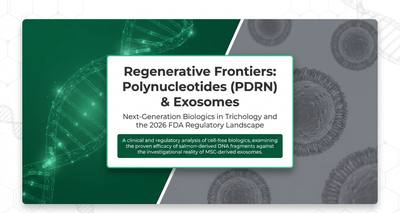
The contrast with MSC-derived exosomes is instructive at the mechanism level. Exosomes are a heterogeneous cargo of vesicles whose contents vary with the source cell line and the isolation process; PDRN is a purified, defined fragment produced by chemical manufacture. One is reproducible by design, the other is variable by nature — which is why the same deck that recommends implementing PDRN immediately labels exosomes as an unapproved biologic to monitor closely while trials mature through formal FDA pathways.
| Property | PDRN | MSC-derived exosomes |
|---|---|---|
| Source | Salmon DNA (Oncorhynchus mykiss) | Extracellular vesicles from MSC culture |
| Manufacturing | Standardized chemical manufacture | Isolation and ultra-centrifugation |
| Batch variability | Eliminated by standardization | Present by nature of the source |
| Regulatory position 2026 | Legally defensible and evidence-backed | Unapproved biologic, IND-classified |
How the dual mechanism shows up in measured outcomes
Mechanism claims are only worth the endpoints attached to them. In 12-week data, PDRN monotherapy delivered via 12 weekly intra-perifollicular injections produced +17.9% hair count and +13.5% thickness. When micro-channels were created and topical PDRN delivered through them, hair count reached +20.4% and thickness jumped to +53.1%, with an 82.1% patient-reported improvement rate.
The thickness gap between the two protocols is the interesting signal. Count gains were similar, but thickness more than tripled in the microneedling arm, which is consistent with improved delivery reaching the matrix-and-bulb processes described above. Anyone comparing regenerative offers in Carlsbad, or anywhere else in California, should ask which delivery route is used, not only which molecule. You can match a protocol to your own pattern with the treatment tools, review the underlying science in clinical hair regrowth science, and check the standing answers on the FAQ page.
| Protocol | Delivery | Hair count | Hair thickness |
|---|---|---|---|
| PDRN monotherapy (Lee et al., 2015) | 12 weekly intra-perifollicular injections | +17.9% | +13.5% |
| PDRN + microneedling (Cho et al., 2016) | Micro-channels plus topical PDRN | +20.4% | +53.1% |
This is educational information, not medical advice, and a qualified provider should assess the individual case before deciding whether a nucleotide-based protocol is appropriate.
Frequently Asked Questions
Is PDRN the same as PRP?
No. PDRN is a standardized, chemically manufactured DNA fragment derived from salmon DNA (Oncorhynchus mykiss), while PRP is an autologous product prepared from the patient's own blood. The deck treats both as legally defensible and evidence-backed and describes combining them for synergistic density and thickness gains.
Why does microneedling raise thickness so much more than injections alone?
Creating micro-channels and delivering PDRN topically through them produced +53.1% thickness versus +13.5% for injections alone, while hair count moved only from +17.9% to +20.4%. The larger thickness response points to improved delivery reaching the matrix and follicle bulb, where mitosis and anagen extension occur.
Does PDRN carry a serious safety risk?
The deck cites over 300,000 global prescriptions with zero serious adverse events in hair loss trials, and attributes that consistency to standardized chemical manufacture, which eliminates the biological variability that affects donor-derived products.
Get matched with hair restoration professionals →
Ready for a Professional Review?
We can connect you with qualified hair restoration professionals who can map your situation to the right treatment.
Get Matched with Hair Restoration Professionals