Regenerative Hair Loss Biologics: What Is Actually Legal in 2026
If you are comparing regenerative hair treatments in Carlsbad, the first question in 2026 is not which biologic sounds most advanced — it is which one a clinic in California can legally administer. As of 2026 the FDA has approved zero exosome products for hair restoration, dermal infiltration, or aesthetic injection, which means a commercial exosome vial is an unapproved biologic and administering it violates federal law. Polynucleotides (PDRN) and activated PRP sit on the other side of that line: PDRN is a standardized, highly purified DNA fragment associated with over 300,000 global prescriptions and zero serious adverse events in hair loss trials, while PRP is a cleared autologous pathway drawn from the patient's own blood. The decision rule is therefore binary — cleared versus investigational — and it should govern every consult you book.
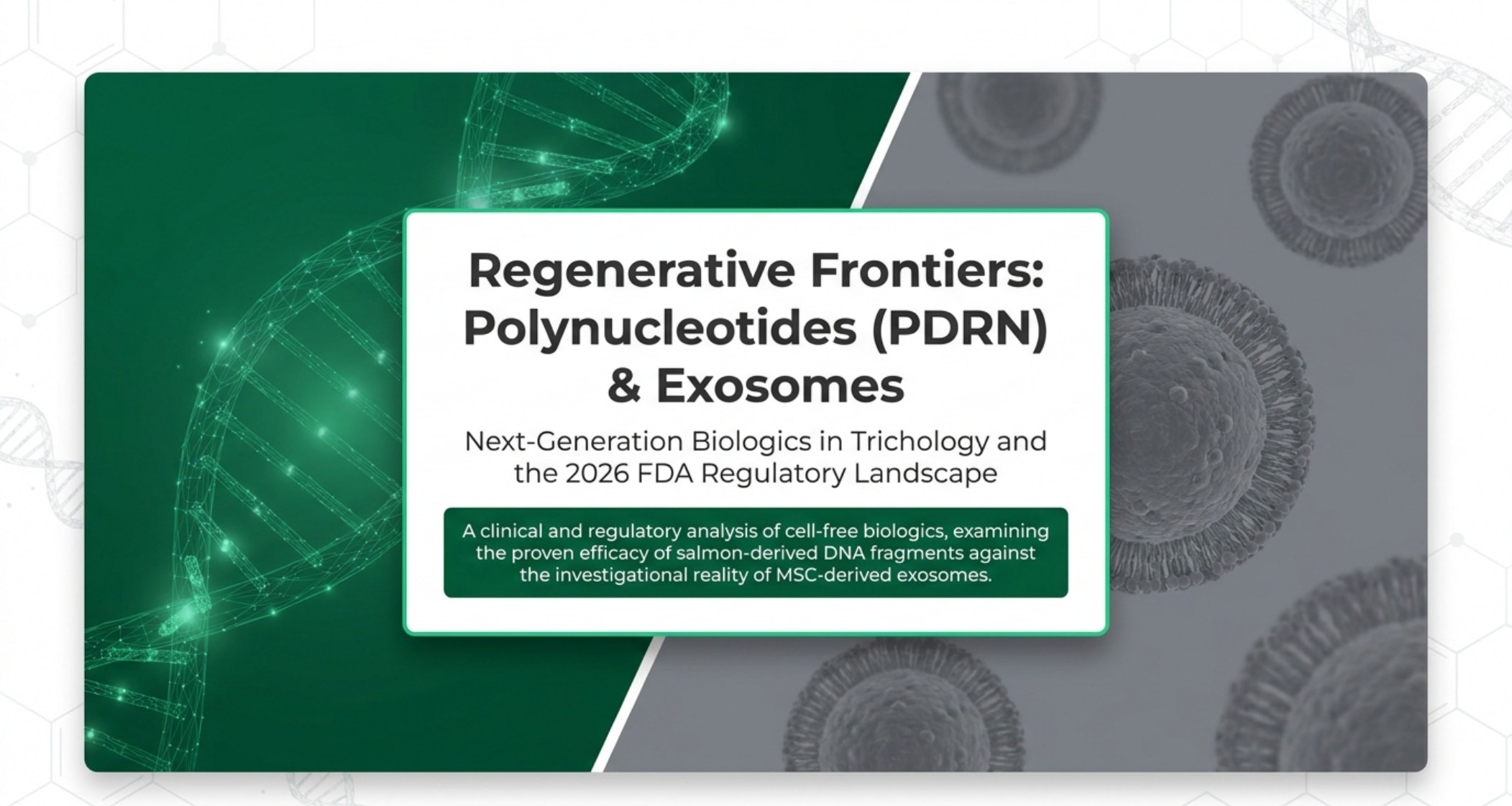
The 2026 legal line: cleared protocols versus gray-market biologics
The 2026 regenerative practice guidelines in this deck split the field into exactly two columns. On one side sit PDRN and activated PRP, labeled legally defensible and evidence-backed, with a clinical action of "implement immediately." On the other sit stem cell-derived exosomes, labeled an unapproved biologic and gray market, with a clinical action of "monitor closely." That asymmetry is not marketing caution. It tracks which products have cleared a regulatory pathway and which are being sold ahead of one.
PDRN's advantage is manufacturing discipline. Standardized chemical manufacture eliminates the biological variability that makes donor-derived products hard to standardize, which is why PDRN can be supplied as a purified, off-the-shelf DNA fragment rather than a bespoke biologic. PRP's advantage is provenance: it is autologous, drawn and re-injected from the same patient, and follows already-cleared pathways. Combined, the deck describes the two as producing synergistic hair density and thickness improvements, which is why PDRN plus activated PRP — not exosomes — is named the foundation of a regenerative protocol.
Exosomes carry the opposite profile. MSC-derived extracellular vesicles show high clinical potential, with early trials reporting Wnt/β-catenin activation and +35 hairs/cm², but a promising signal is not a legal pathway. Until those trials mature through formal FDA approval, a clinic selling commercial exosomes is distributing an investigational new drug without the trial structure that makes investigational use lawful.
| Modality | Regulatory status | Recommended action |
|---|---|---|
| PDRN (polynucleotides) | Legally defensible, evidence-backed | Implement immediately |
| Activated PRP | Cleared autologous pathway | Use as protocol foundation |
| MSC-derived exosomes | Unapproved biologic / gray market | Monitor closely only |
| FDA-approved exosome products for hair restoration | Zero as of 2026 | None available |
Why exosomes fail the human cell and tissue exemption
The legal mechanism is 21 CFR 1271, the section covering Human Cells, Tissues, and Cellular and Tissue-Based Products (HCT/P). Four criteria must all be satisfied for a product to sit inside the exemption. Standard exosome products fail the first two outright and often fail the remaining two.
Minimal manipulation fails because isolation, ultra-centrifugation, and filtration fundamentally alter the raw biological source material. Homologous use fails because exosomes are marketed for conditions far removed from their tissue of origin — adipose or umbilical derivatives used to treat scalp alopecia. The no-combination-with-other-articles criterion often fails, and so does the no-systemic-effect criterion: even topical application after microneedling is viewed by the FDA as systemic drug delivery rather than cosmetic use.
The consequence is the IND mandate. Because these products fail the criteria, they are legally classified as Investigational New Drugs requiring authorized Phase I–III clinical trials before any commercial administration. There is no ambiguity in the statute — only a gray market in practice.
| Criterion | Evaluation | Reason |
|---|---|---|
| 1. Minimal manipulation | FAIL | Isolation, ultra-centrifugation and filtration alter the source material |
| 2. Homologous use | FAIL | Adipose or umbilical derivatives marketed for scalp alopecia |
| 3. No combination with other articles | OFTEN FAILS | Combined manufacturing and delivery steps |
| 4. No systemic effect | OFTEN FAILS | Topical application post-microneedling read as systemic drug delivery |
What the 2025–2026 enforcement record tells you
The 2025–2026 period saw escalated FDA enforcement, with formal warning letters issued to major manufacturers for distributing unlicensed biological products and for failing to validate cGMP sterility. Two failure modes dominate those letters: the license question and the sterility question.
Sterility is the safety edge of the same problem. A product without validated cGMP sterility cannot be assumed sterile, and dermal infiltration or aesthetic injection carries whatever is in the vial directly past the skin barrier. The deck's risk summary for exosomes names three exposures at once — severe legal risk, malpractice risk, and safety risk from sterility — none of which a patient can audit from a brochure.
PDRN's safety profile is documented in a different way. Over 300,000 global prescriptions with zero serious adverse events in hair loss trials is the figure the deck cites, and standardized manufacture rather than donor variability is the mechanism behind that consistency.
| Failure mode | What the FDA cited | Exposure created |
|---|---|---|
| Licensing | Distributing unlicensed biological products | Severe legal risk |
| Sterility | Failing to validate cGMP sterility | Safety and malpractice risk |
What a defensible regenerative protocol looks like
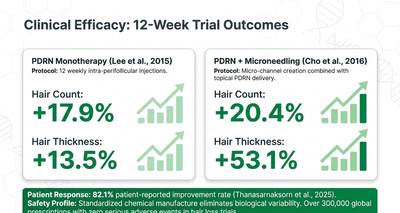
For a Carlsbad patient, the practical translation is a protocol built from cleared components and measured against trial-grade endpoints. PDRN monotherapy in the 12-week data used 12 weekly intra-perifollicular injections and produced +17.9% hair count and +13.5% thickness; adding microneedling channels to topical delivery lifted hair count to +20.4% and thickness to +53.1%. Those are the numbers to hold a provider to when the word "regenerative" is used.
Ask which product is being injected, whether it is cleared, and what happens if the answer is unapproved. A defensible plan runs PDRN and activated PRP now and defers commercial exosomes until trials complete. You can compare formats side by side on the comparisons page, read how a treatment sequence is built in how it works, and request a provider match at the quote form.
| Element | Cleared approach | Gray-market approach |
|---|---|---|
| Core products | PDRN plus activated PRP | Commercial MSC exosomes |
| Session structure | 12 weekly intra-perifollicular injections | Not defined by an approved protocol |
| Measured endpoints | Count +17.9%, thickness +13.5% (monotherapy); +20.4% / +53.1% (with microneedling) | Early-trial signal only, e.g. +35 hairs/cm² |
| Safety record | 300,000+ prescriptions, zero serious adverse events | No defined post-market record |
This is educational information, not medical advice, and a qualified provider should assess the individual case before any biologic is injected.
The regulatory split also explains why price gaps in California are so wide. A cleared, manufactured PDRN fragment has a defined supply chain and a documented safety record; an unlicensed vial has neither, which is precisely why its legal and malpractice exposure cannot be quantified in advance. Cheaper is a trade-off against exactly the risk you cannot price.
Frequently Asked Questions
Are exosomes legal for hair restoration in 2026?
No. As of 2026 the FDA has approved zero exosome products for hair restoration, dermal infiltration, or aesthetic injection, and administering unapproved biologic products violates federal law. Because standard exosomes fail the 21 CFR 1271 exemption criteria, they are legally classified as Investigational New Drugs requiring authorized Phase I–III trials.
What does PDRN actually do to a miniaturized follicle?
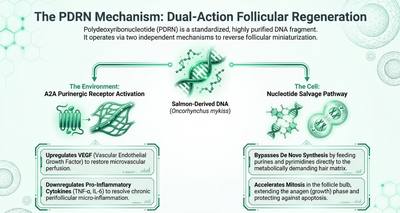
PDRN works through two independent mechanisms: A2A purinergic receptor activation that upregulates VEGF to restore microvascular perfusion and downregulates the pro-inflammatory cytokines TNF-α and IL-6, plus a nucleotide salvage pathway that feeds purines and pyrimidines to the hair matrix and accelerates mitosis in the follicle bulb.
How large are the measured gains from a PDRN protocol?
In 12-week data, PDRN monotherapy produced +17.9% hair count and +13.5% thickness, while PDRN plus microneedling reached +20.4% hair count and +53.1% thickness, alongside an 82.1% patient-reported improvement rate.
Get matched with hair restoration professionals →
Ready for a Professional Review?
We can connect you with qualified hair restoration professionals who can map your situation to the right treatment.
Get Matched with Hair Restoration Professionals